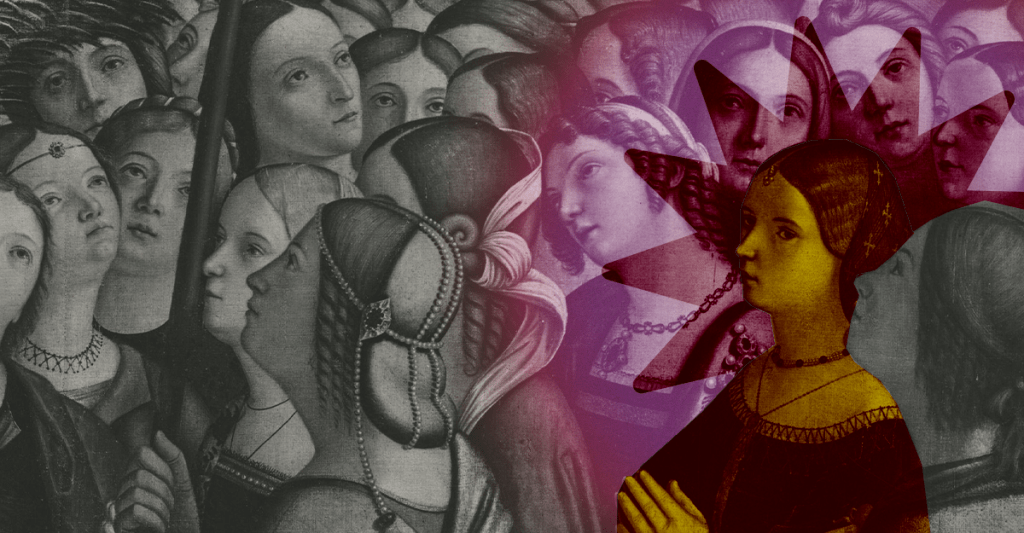
In this post and the previous, I pull out some stories from my personal library. Specifically, from my Herstory shelf. Below you’ll find a brief constructed history of the Casa della Pietà, a Florentine home for abandoned girls.
Lost Girls1
Though it’s through the Inquisition and its guilty verdicts, Lucrecia kept her name with her story attached. For the girls of the Casa della Pietà, their names were line items in a ledger recording what came into the Casa (unfortunate girls) and what came out (yards and yards of silk woven by those unfortunate girls). The story starts in Florence.
Florence had a reputation as a city of sexual depravity (florencing was common German slang for sodomy). And as hordes of horny young apprentices flooded the city in migrations like a Renaissance college welcome week, the satisfaction of these sexual appetites became a municipal problem.
Throughout the fifteenth century, Florence supported a tiered regime of licensed prostitutes, red light districts, and civic-run brothels. Like all novel municipal programming, this system was subject to the forces of reaction. Prostitution was much more visible to the Florentines than it is to us today, so the city-wide efforts to reform the sex trade in the 1550s were easy to sell. Imagine your sister was like that woman. Or you died and your mother had to become one of those women.
Sixteenth century Florence projected her anxieties onto her teenage girls. Their virtue – that is, their virginity – was a political and economic asset to their family as much as it was a sexual one. Many girls were married to business associates, and others took vows. The civil brothels were a necessary evil for the growing merchant and middle classes: the lustiness of the professional few meant the intact purity of the many. But what about those who fell through the cracks? The girls orphaned and abandoned? Florence had a novel solution: a place to stay.
A social welfare alliance, the Virgins confraternity opened several homes for abandoned girls. The best records come from the Casa della Pietà. Every girl that came in was registered by the Prioresses, nearly a thousand passing through. The average girl was just 12, from a family with neither money nor deep roots. They left the Pietà at 16 or 17, some returning to their families, a small handful with a husband, a smidge becoming nuns. The majority died within three years. What was killing them?
Maybe they worked to death. It took 10,000 lire a year2 to keep the Pietà running. Growing girls had to eat, and olive oil cost money. Patrons made annual pledges, and churches were happy to donate now that they didn’t have to care for the girls, but that didn’t make ends meet. The girls, the best portraits of sympathy, took collection boxes around the neighborhood for any change that shopkeepers could spare. Other girls worked as domestic servants on contract. For her trouble, the employed girl ate at her master’s table, which was certainly better than whatever gruel the Prioress could throw together. But the real work was within Pietà’s walls: wool weaving.
Within two years, Pietà was running its own textile mill. In 1555, two women taught the hundred-something girls living there to weave on the few small looms that cramped the old hospital they lived in. By 1557, the textile operation was run by two barely-trained teen girls, and it somehow turned a profit. Wool wasn’t bad, but worms were better. Silk worms, that is. Soon the Pietà’s tender-fingered younger girls spun silk, while the older girls wove wool.
No matter the job, the girls worked hard. What choice did they have? When they called it a day, they shared beds. Overcrowding and overworking often manifested in ringworm or respiratory problems. A small few even contracted morbus virgineus, an illness which afflicts millions of girls annually to this day. Female puberty. The infirmary of the Casa della Pietà had a stocked cabinet of treatments for these ailments. It also had a notable collection of abortifacients.
Maybe it wasn’t work that killed them. Sex wasn’t suddenly invented in the 60s, and the Renaissance medicos were armed with treatises and poultices to alleviate the pains of Eve’s punishment.3 It cannot be emphasized how much The Pill revolutionized being a woman. If you could not preemptively prevent pregnancy (Renaissance condoms are a whole ‘nother blog post), you had two basic choices ahead of you: give birth or get rid of it. If you were a servant girl working for an uncouth, abusive master, you could very well be assaulted. In 1539 almost 40% of baptized children in Florence were illegitimate, many, undoubtedly, born from less-than-loving situations. Though Florence had previously built a legal market around the sexual needs of strapping young men, by the sixteenth century the law surrounding sexual conduct had perfected the worth of women; the fine for raping a widow, a married woman, or a respectable virgin was 500 lire; a servant girl, just 25 lire; if your victim was a prostitute, no cost at all.
Not every girl who left the Casa della Pietà for work faced assault and abuse, but the girls who sought refuge there were among the most vulnerable in Florence. No one would bat an eye if a producer scouted them for the Renaissance century equivalent of 16 and Pregnant. Those poultices that the Prioress kept in the infirmary were there for a reason. But even in the sixteenth century abortion was not a death sentence.
So what was killing the girls of the Casa della Pietà? The best guess we have4 is – drum roll please – syphilis.
How do you catch syphilis in sixteenth century Italy? Contemporary medical authorities thought basically anywhere. Anything that could be shared – clothes, bedsheets, dining utensils, cups, even toilets – could teem with infectious air. Nursing infants were especially vulnerable, suckling infected breasts or accepting a sweet kiss from a loved one with an open sore. Whether congenital or acquired in adolescence, syphilis was unforgiving. A parent might see their pre-teen daughter suffering aching joints, tremors, seizures, and the soft flesh inside her mouth disintegrate. And what do you do if you’re rootless, desperate, and your daughter is rotting alive? You leave her to the grace of charity.
The girls who died at the Casa della Pietà were already marked for doom. The network of charity homes set up to care for them – and other undesirables at other stages of life – was a remarkable effort of Florence’s civic leaders to do something about the people in the city, borne from a genuine care for the vitality of the city. And yet by 1570, politics in Florence had taken a reactionary turn. To keep running, Pietà was subject to and had to enforce restrictive measures that took all the fun out of being a girl. Female visitors were barred from overnight visits, and girls couldn’t wash each other’s hair. Girls couldn’t sing love songs while working, nor joke about sex or marriage. Gossip was punished. Romantic novels were banned. Dare talk back and your hair would be cut. Patently unfun.
In conclusion
It’s obvious but it bears repeating: this isn’t an exhaustive review of Being a Teenage Girl in the sixteenth century. We’ll never have a corpus of a million diaries to dissect. Literacy wasn’t a given, books are fragile objects, and they didn’t have Tumblr.
For all of the ways life as a young woman then is unrecognizable to us now (the Inquisition, weaving on looms, publicly-managed brothels), there are plenty of others that look identical (sharing secret sex tips, gossiping, daydreaming about love).
- Lost Girls: Sex and Death in Renaissance Florence (Johns Hopkins University Press, 2012) by Nicholas Terpstra. Feelings: mine. ↩︎
- A lot. It’s a lot of money. ↩︎
- The Renaissance mind was infinitely more creative than the modern when it comes to what could pop out of a womb. Per Terpstra: maybe a toad or “some other fatally poisonous animal”; intercourse during menstruation would lead to a monster of some sort rather than a darling cherub. ↩︎
- This whole section owes itself to Nicholas Terpstra, but this portion in particular is impossible without his scholarship. ↩︎


Leave a comment